Why Does Norway Have Such Beautiful Toilets?

Norway's most spectacular toilets are not luxury bathrooms. They are roadside architectural landmarks, built into some of the country's most dramatic landscapes.
Contents
The explanation starts with the Norwegian Scenic Routes project.
Norway selected 18 roads across the country and began transforming them into a coherent tourist attraction. The roads themselves pass through fjords, mountains, coastlines, waterfalls and Arctic landscapes, but the project also invested heavily in the places where travelers stop.
According to the Norwegian Public Roads Administration, these stops have to provide ordinary practical functions — parking, toilets, paths and information — while also enhancing the experience of the landscape. The architecture is intended to be an attraction in itself.
Ureddplassen — The Wave-Shaped Toilet


If there is one toilet that explains the whole Norwegian phenomenon, it is Ureddplassen.
The building looks like a concrete wave frozen in motion. Its curved roof rises from the ground before sweeping back down toward the sea, while translucent glass gives the small structure a warm glow after dark.
But the architecture is only half of the story.
Ureddplassen sits on a nine-metre-wide terrace overlooking the fjord and open sea, with views toward Fugløya and the Lofoten Wall. The terrace also incorporates Norwegian marble seating and steps descending toward the shoreline.
The location has a darker history too. A memorial at the site commemorates the crew of the Norwegian submarine Uredd, which sank after hitting a mine during the Second World War.
That combination — memorial, landscape, architecture and infrastructure — is typical of the Scenic Routes philosophy.
The toilet isn't treated as an isolated object. It is part of the entire landscape experience.
The effect is especially dramatic at sunset, when the translucent walls glow against the mountains and sea.
Stegastein — A Bathroom Above the Fjord


Stegastein is better known for its spectacular viewing platform, but the toilet is part of what makes the stop so unusual.
The viewpoint projects approximately 30 metres out over the mountainside, around 650 metres above the Aurlandsfjord. The architecture creates the illusion of floating above the landscape.
And then there is the bathroom.
The service building was deliberately positioned slightly over the edge of the cliff, allowing people inside to experience the view while maintaining privacy.
Norway's official tourism site notes that the Stegastein toilets have even been included among the world's 10 best public toilets by DesignCurial.
It is perhaps the clearest example of the Norwegian approach: even something as mundane as going to the bathroom can become part of the experience of a spectacular landscape.
Ersfjordstranda — The Golden Toilet


This is probably the most ridiculous-looking toilet on the list — and that is precisely why it became famous.
At Ersfjordstranda, a small triangular toilet building is covered in gold-colored cladding. Against the white beach and sharp mountains of Senja, it looks almost absurdly luxurious.
Norway's Scenic Routes organization calls the building a tourist attraction in its own right. It was completed in 2014 and designed by Tupelo Arkitektur.
The nickname “Golden Toilet” or Gulldassen stuck.
But there is an important 2026 update for anyone actually planning a visit.
The area has undergone a major upgrade, and a new service building opened on August 27, 2026. It contains three toilets, including an accessible toilet, as well as a kiosk and information facilities. The original golden triangular toilet remains the recognizable architectural attraction from the earlier project.
So the famous golden structure is now part of a larger, upgraded visitor facility rather than the only bathroom at the beach.
Eggum — A Toilet in Lofoten


Eggum is an excellent example of how Norwegian architecture can become almost invisible inside the landscape.
The rest area sits between the ocean and mountains on Vestvågøy in Lofoten. Instead of creating a conventional building, the designers integrated the facilities into an amphitheatre-like structure.
The site also contains the sculpture Hode, a work by Marcus Raetz, positioned to look toward the sea.
The architect was Snøhetta, the internationally known Norwegian architecture practice. Visit Norway describes Eggum as the firm's smallest design among the Scenic Route toilet projects.
There is also an unusual historical layer to the place. The rest area is located beneath the remains of a German radar installation from the Second World War.
Selvika — The Concrete Spiral


Selvika might be the most architectural-looking bathroom on this list.
The structure resembles a gigantic concrete ribbon or spiral unfolding down toward the sea.
The idea behind the project was not simply to build a toilet but to make the journey from the road to the beach part of the experience. The path curves gradually downward, turning the movement itself into architecture.
The project was designed by Reiulf Ramstad Arkitekter, one of Norway's best-known contemporary architecture firms.
At the bottom of the path is Sandbukta beach, while the surrounding area contains archaeological traces dating back to Neolithic settlement and Sámi culture.
The result is a perfect example of the Scenic Routes philosophy: a practical stop becomes a small architectural landscape.
Tungeneset — Toilet Under the Northern Lights


Tungeneset is one of those places where the landscape is the architecture.
The rest area occupies the tip of a promontory separating the Steinsfjord and Ersfjord. A wooden walkway extends across the rocks, allowing visitors to experience the coastline and the mountain Oksen.
The toilet facilities are deliberately subordinate to the landscape.
That makes Tungeneset particularly beautiful in winter photography, when the northern lights can appear above the dark coastline.
Visit Norway specifically highlights the location as one of its designer restroom destinations and notes its appearance under the northern lights.
This is less about an outrageous building and more about getting the infrastructure out of the way of the view.
Tyrvefjøra — The Fairytale Toilet


Tyrvefjøra may have the most charming name for a public bathroom: Norway's tourism authority literally calls it a “fairytale toilet.”
The service building consists of two separate toilet structures built from pine trunks and concrete, covered by a large roof that appears to float above the landscape.
The architects, Helen & Hard, designed the building around the geology and character of Hardangerfjord.
The use of timber is particularly appropriate here. Rather than trying to compete with the fjord and mountains, the building feels like something that could have grown out of the surrounding landscape.
It is also an excellent example of why these toilets work so well visually: they are small enough to remain human-scale but distinctive enough to become recognizable landmarks.
Ostasteidn — The Toilet That Blends Into Nature


Ostasteidn takes the opposite approach to the Golden Toilet.
Instead of shouting “LOOK AT ME,” the building is intended to gradually disappear into its surroundings.
The design allows moss to grow across the outer walls, effectively turning the building into part of the landscape. Visit Norway specifically highlights the project as an example of a toilet designed to camouflage itself through vegetation.
The site overlooks Sandsfjorden and was designed with reference to the Norwegian artist Lars Hertervig, who found inspiration in this landscape.
Flesefossen — Toilets Beside a Waterfall


At Flesefossen, the toilet is incorporated into a much larger architectural structure.
The project was completed in 2023 by Haugen/Zohar Arkitekter. Its steel and wood structure follows the flowing lines of the surrounding landscape, drawing inspiration from the river, waterfall and glacial potholes.
The toilets sit within a long structure that also contains seating and creates a viewing platform and amphitheatre facing the waterfall.
This is a recurring theme in Norwegian Scenic Routes: the bathroom is only one component of a complete place.
You stop because you need a break, but then you end up sitting outside, looking at the waterfall, walking around the viewpoint and taking photographs.
Oscarshaug — A Mountain Toilet


Oscarshaug demonstrates what happens when a tiny functional building has to survive serious mountain weather.
The rest area offers views toward the Hurrungane mountains, including Store Skagastølstind. The toilet itself received a substantial steel superstructure during its renovation, giving it an almost futuristic, reinforced appearance.
Visit Norway jokingly compares the reinforced structure to something resembling a Viking helmet.
There is a practical reason for the heavy construction. The location is exposed to harsh mountain conditions, and the Scenic Routes program has had to design facilities capable of surviving them.
It is a good reminder that Norwegian scenic-route architecture is not purely aesthetic. These buildings have to work.
Allmannajuvet — Peter Zumthor's Toilet


Allmannajuvet takes the concept in a completely different direction.
The site was once a zinc-mining area, operating from 1881 to 1899. Today, the abandoned mine has been turned into a cultural attraction with a gallery, café, paths, parking and toilets.
The architectural installation was designed by Peter Zumthor and his practice, one of the most internationally celebrated names in contemporary architecture.
Rather than making the buildings imitate the natural environment, the design responds to the site's industrial mining history. The Scenic Routes organization describes the buildings as having an industrial construction style that embodies the story of the mines.
So yes, there is a famous architect's toilet in an abandoned Norwegian zinc mine.
Bukkekjerka — The Arctic Rest Stop


Bukkekjerka is perhaps the most dramatic example of a bathroom placed in the Arctic landscape.
The rest area sits on the Børhella promontory on Andøya, where the road separates steep mountains from the open sea.
The site has an old Sámi sacrificial site, remnants of historic settlement and an exposed coastline where visitors can experience the midnight sun. The architectural installation was designed by Morfeus Arkitekter.
There is, however, an important current warning.
The Bukkekjerka facility is presently closed until further notice because of the current security situation. The Norwegian Scenic Routes authority currently directs visitors to a nearby toilet in Sandvika instead.
So this is one to save for a future itinerary rather than assume you can currently use the facility.
Other Norwegian Toilets Worth Adding to Your Road Trip
The twelve examples above are not the end of the story.
The Norwegian Scenic Routes network contains many other architecturally interesting service buildings and rest areas.
Kvanndal


Kvanndal has a small toilet and waiting building beside the Hardangerfjord. Its architecture uses a traditional grindbygg timber-frame idea combined with glass walls and a distinctive illuminated glass roof.
Liasanden


Liasanden is located inside a pine forest and was the first rest area completed as part of the Scenic Routes program. It reopened in 2024 after upgrades, including improved toilets and new outdoor facilities.
Hamningberg


At the end of the Varanger route, Hamningberg has new toilets and a redesigned rest area serving travelers arriving at the remote former fishing village.
Final Thoughts: The Norwegian Art of the Toilet Stop
The funniest thing about Norway's beautiful toilets is that they aren't really about toilets.
They are about what happens when a country decides that even a five-minute roadside break deserves good architecture.
Norway could have installed anonymous concrete boxes and moved on.
Instead, it commissioned architects.
It built bathrooms beside fjords, on Arctic beaches, above mountains and inside old mining landscapes. It used concrete, timber, steel, glass, stone and even gold-colored cladding. Some buildings almost disappear. Others demand to be photographed.
And that is why the phrase “Norway's beautiful toilets” has become such an effective travel story.
The bathroom is just the excuse.
The real attraction is the idea that even the most ordinary part of a road trip can become an encounter with architecture and landscape.
So the next time you're driving through Norway and see a sign for a roadside rest area, don't automatically keep going.
There may be a very good reason to stop.
And yes — it might be the toilet.
Frequently asked questions
Explore lists in this city
The Ultimate City Guide
Oslo, Norway
Free
Ultimate Oslo food guide
Oslo, Norway
Free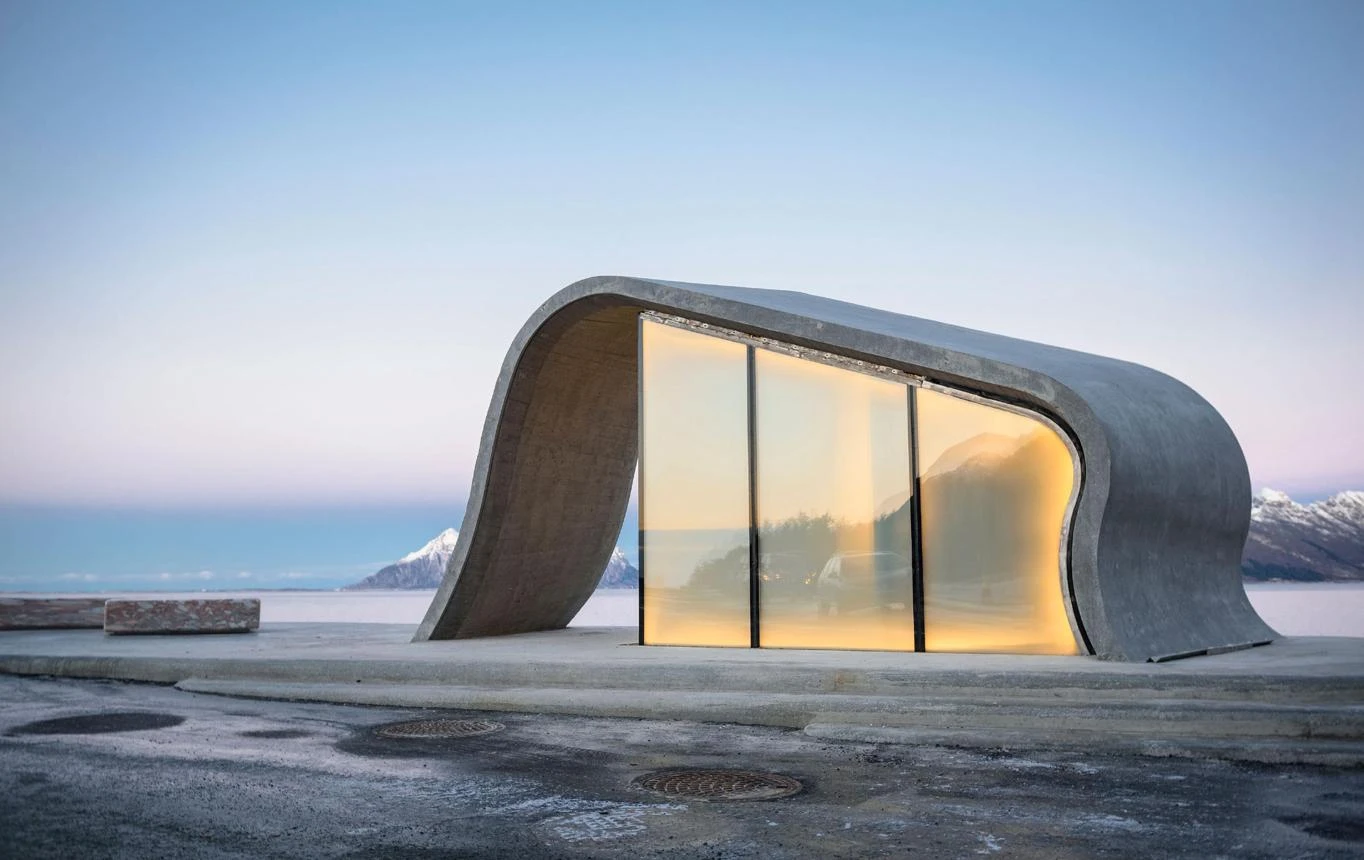
Norway's Scenic Restrooms
Norway
Free